This isn’t one of those posts that leads to a solution or an “ah-ha” moment at the end. It’s not even one that has a happy ending. It questions the truth of self-fulfilling prophecies, and the law of attraction.
My recent session at the psychologist (yeah, one day I will write an article on how worthwhile they truly are), was all about questioning some of my core beliefs. And to my surprise, one of core beliefs, which didn’t come up in the session, but continues to hold true, is that “as I start to make change in any issue, the universe sends something along to test that resolve”. I have to “prove” that I am stronger, healthier, mentally stable, capable, etc. Eg, I am saying no to ice cream, and my daughter pleads with me to go to McDonald’s and buy her and I a McFlurry – how do I say no to that?!
The question that is often asked prior, as I am trying to make sense of my heightened state as a core belief is challenged, is “what’s the worst that can happen?” Eg, what if I am late to an appointment?; what if I say yes to ice cream, when I have decided to say no?; what if I don’t tell my daughter that I love her and the exact time that I will see her next, as I drop her to school of a morning?; what if I don’t answer that phone call? … truly, in my brain, an unrelated, but equally (potentially) tragic/scary event, that’s what! … and that’s where we are at now …
The unrelated event … I opened the Pandora’s box this morning with a realisation about my family, only for me to receive this message from my sister.
Yeah, I get that isn’t the way the world works, but this is the way that my brain works, and I want to share this, because in reading this very long and messed up message from my sister today, I know this became more about her issues, and the psychologist is right – it literally has no power unless I give it the power to affect me.
So, for context, my Father passed away in March, as the patriarch of a toxic family, and names are changed to protect privacy. I will also add a little note that I found funny … my sister signed this email MHFA Accredited … and when you look up details of that, it’s a free course, that anyone can do, that talks about Mental Health, literally making her look like she has got authority on the topic, when in fact, actually has none at all.
~*~
I have spent the last week deliberating over whether or not to send this to you. And tbh, I’m beyond disgusted that I need to, and no doubt Dad would be the same. I have something to say to you all, and since I don’t have everyone’s email addresses, I’m sending to the addresses I do have. TBH, I really don’t care if you pass on the message or not.
Celine – for as long as I can remember, you have always insisted that as the eldest, you were the most responsible. Yet you not only failed Dad, you failed this family in the most spectacular fashion. For decades you have criticised anyone who stole from those less fortunate – and face it, you can’t get much less fortunate than DEAD. Yet here you are, making every excuse to justify your despicable act. There will never ever be justification for what you did. There will never ever be room for forgiveness for what you did. I’ve spent my life defending my actions to you – I got into the Army….apparently it was because ‘they let anyone in now days’; I had the first grandchild….you yelled at me, telling me it was your RIGHT as the eldest child, to have the eldest grandchild, and I was stealing what was rightfully yours; I fell pregnant with my second child….you accused me of ‘stealing’ your thunder because you happened to be pregnant at the same time. And these happened before I was 25…the list goes on, trust me.
You asked me if I thought it was a good idea to be a prostitute – like who asks that sort of question of their younger sister. You asked me if it was ok that you deceive your ex-husband to have a second child because you needed someone to love you unconditionally – how’s that working out for you now?? I began working in healthcare, but apparently I couldn’t possibly know as much as you, despite the list of accreditations I have accrued, because I haven’t been in the industry as long as you…pfft…what a joke! I’m done having you question and criticise me, especially since you clearly can’t get your life on track. No, I’m not perfect, but at no point in my life have I ever walked away from my children and not bothered to contact them for months! It hasn’t always been easy, but I am proud of how hard I fight for my children – and how I’m teaching them there is a better way.
Stacey – I don’t give a flying rats what you choose to be called, just in case you decide to tell me ‘it’s Tracey’ in your contempt-laden voice. For a long time I looked up to you. You appeared to be intelligent and despite a few hiccups, you seemed to have clear life goals. But looking back now, I can see the narcissistic behaviours which led to the demise of both of your marriages, and which will lead to the corruption of the innocent soul that is your daughter. You made the decision recently to exclude me from your life – for what reason, I will probably never know. You have always chosen to draw good honest people into your world, then seek to destroy them with overly controlling behaviours and a lack of love. I’m thankful that I raised Benjamin strong enough to see past your bullshit (yes, he’s told me plenty of your controlling behaviour towards him).
As for recent events, your behaviour at Dad’s funeral, whilst not surprising, was hideous. In every photo my Daughter took of you during that time, you had the ugliest expressions on your face – most filled with contempt and disgust towards those around you. Clearly you were there out of some mis-guided duty as his second-born daughter….he would have been ashamed….you should have just never bothered coming. I pray that one day, your daughter is strong enough to see past your bullshit. Oh, and feel free to send this to a lawyer – there are no threats in this, there is no harassment, there is nothing more than a sister expressing her thoughts and emotions – which is not a crime in Australia.
Shane – Since before you were born, Dad put your needs ahead of everyone else’s, even if it meant other people suffered at your expense. And despite getting every opportunity, you did nothing. You threw hate, contempt and illegal activities at everyone around you – and you didn’t care who you hurt in the process. There was a time when your actions almost resulted in myself and 2 of my children living on the streets. Another time, you stole all the fuel out of my car, despite me needing it to travel with my baby some 400km – because clearly you needed it more than me. You have threatened to kill me and anyone around you who doesn’t agree with you. You use your health issues as excuses for bad behaviour, and you use violence to intimidate and control.
For a short time, I thought you had overcome this. Yet despite having a near-perfect woman at your side, you chose violence as the solution to your problem – and it got you arrested. Then, when I went out of my way, putting my mental health at risk, you chose to abuse me, rather than deal with your concerns like a civilised human being. The list of atrocities you have committed in your life is more than any person I’ve ever met – to know that I’m related brings shame. You don’t have Dad anymore to bail you out. You don’t have Dad protecting you. You don’t have Dad to help you fight your battles. And all of us who were willing, are now done with your violent tendencies – you are on your own.
Melanie – The baby sister. For decades I have defended you. For decades I have helped you. For decades I have gone against the grain to support you finding your feet. I helped you in your darkest hours and your brightest days. I have been the one person, your whole life, who had your back, no matter what. So you can imagine the pain I felt, to have you throw my help back in my face, and treat me with such contempt – behaviour I expected from your siblings. Not you. Out of all the siblings, I expected better from you. I’m truly heartbroken. Don’t let your lack of book-smart intelligence destroy your heart or mind.
To you all – I have removed you all from my social media accounts. At this stage in my life, you do not deserve the honour of watching my children grow into civilised human beings. You do not deserve the honour of being called Aunty or Uncle. My children will never experience the horrible behaviour exhibited by you all. And unless you work out how to fix this chaos – and fix it, my children will never know you.
Dad and I were not always on great terms, but even when I really hated him, there is NO WAY I would have treated him or his memory so despicably. I miss him more than words can describe, and my mental health has taken a nose-dive since his passing – your behaviour added to my despair, which is why I decided to remove the open access once freely granted. You all have my phone number…. I suggest for the foreseeable future, you don’t call. Although, if you do have the overwhelming, uncontrollable urge to contact me, send a text, maybe one day, I’ll reply.
I wish you all whatever the universe believes you deserve.
Your heartbroken sister. MHFA Accredited. (Mental Health First Aider)
For some of us, technology is this big, scary, not at all understood THING, and we have even less capacity to control it. But technology has been around as long as you have. What we are talking about here though, is another step up from the tech you already know. You know what it’s like to have electricity to turn on lights in your house, and to dial a number into a phone to call a friend for a chat or a taxi to take you to the shops, or even clean your clothes in a washing machine. The next step however, is to allow these mundaine tasks to be a little easier, or even just something we don’t even have to think about. And for some, technology allows us to do things that our body or situation limits us doing, and for me, that’s where the joy of technology really lies. Imagine waking up of a morning, to your house already warmed to how you like it, and the kettle boiled, ready for that first cup of tea in the morning! 😀
Some transparency before I start though, this is written from the perspective of both the physical and social/emotional limitations that both my daughter and I currently have, living in a regional Australian city. It’s fair to say, I cannot cover all disabilities, and I have no desire to cover every piece of tecnology, but hopefully it will encourage you to try. And some of our technology is funded by Australia’s National Disability Scheme (NDIS), and some of it is just personally acquired and appreciated!
Mobile phone / Smartphone – Yep, I am going to start here. 90% of all adult Australian’s own a mobile phone, if not a smartphone (it’s now quite hard to buy a mobile that isn’t a smartphone, and the difference is the capacity to interact with the screen). Falls alarms have SIM cards in them, and so much of the technology that supports us, starts with the items we can carry with us.
Internet – specifically NBN, or the National Broadband Network. Again, with over 90% of all Australians having access to a fast stable internet, and plans that average as low as $50/month, this is almost a given, and pretty much ALL of the “Internet of Things” category needs internet to connect and access.
Voice Assistants (Google Hub, Alexa, Apple Homepod and a few others) – Now this is really where we start to get super-techy! These little beasts are the basis to all “voice control” capabilities. When I wake of a morning, I say “OK Google, Good morning!”, and it responds with the weather for the day, my first 3 calendar events, the current news, and two particular podcasts that are relevant to me. This allows me to have a clue how to dress myself and my child, what we have planned for the day (let’s be honest, we can easily forget!), what’s going on in the world, and then topics of interest to me while I am making my first cup of coffee. Voice assistants allow for many other daily tasks as well, but for most part, access to information is literally a question away. And for those concerned about the “something in my house is listening to me”, the security built into these devices is ever-increasing, and due to international laws, is being designed with privacy in mind.
The next group of technologies fits into the affectionately named “Internet of Things” (IoT), and yeah, they really can make your life a whole lot easier, but they are somewhat dependent on having one to all three of the first listed technologies.
Automatic Thermostat (Sensibo / Eve / Tado) – These little beasts either attach to a wall (or in my case, sometimes just on the top of the bookcase), and are a thermostat, and allow for voice control of remote controlled heating and cooling aircon units, heat pumps, and the like. I can both turn on the aircon unit by voice at any time of the day, or can set it on auto, so that when criteria are met, the aircon unit kicks into action automatically (ie, the air temp in the living room drops to 12 degrees anytime from May to August every year, the aircon automatically kicks in, and heats to a minimum of 18 degrees).
Falls/Personal Alarm – SureSafe is the version I use, which is IP65 rated (water and dustproof), and allows me to schedule in 5 numbers into it, and if at any time I breach the parameters that have been set, it will alert all of the contacts to my current situation, and a map of location. There are a number of varieties, however having one that has a SIM card (for mobile reception) pre-installed, allows this to be a fully portable device. Mine also comes with a myriad of options to attach to myself, so it’s always on me.
Smart Watch (Apple Watch, Samsung Watch and so many other choices here) – specifically Apple and Samsung have a ‘connected watch’ that by the beginning of 2021, are the only two brands that have medical falls technology built into the watch. But if you already have a Falls/Personal Alarm, then a smart watch can still be of assistance, just not for emergency situations. And if you are someone who wears a watch, this is a great transition into wearable technology. However, smart watch can offer so much more – I can take a phone call, add to my shopping list (by talking to my watch), read emails and texts easily, check in with my heart rate and do mindfulness when I have an anxiety attack, record a conversation that I am part of, check the weather at a glance, start/monitor a workout, pay for a cup of coffee while out and about, and many more. Of course, it will need a smartphone to connect to.
Automatic Vacuum/Mopping Robots (Roomba) – Single level dwellings, especially if you have cats or dogs, automatic vacuum or mopping robots are a godsend. They will do this dreaded task with almost zero effort. I have had the most popular model for more than 5 years, and while the technology has changed considerably in five years, it takes one press of a button to automatically vacuum my whole house, and it actually gets into the places that a standard cleaner and vacuum cannot.
Electronic Kettle / All in One Cookers – Yeah, ok, Electronic Kettles are definitely not on the critical list, but there is something just blissful to waking up, pressing a button on my phone, and KNOWING that my kettle is going to stay hot until I get my lazy butt to the kitchen to make my essential cup of coffee in the morning. I haven’t gone so far as having a robot to bring it to me, and it’s possibly the perils of single-life-parenting – it’s just something I won’t let my 6yo do! A more controversial ‘kitchen tech’ is the Thermomix (or other all in one ThermoCookers) for ease of cooking. There’s a number of different brands in this category now, but it is one of the items I use in the kitchen a lot, especially from a fatigue management perspective – I can literally sit on a chair, and put in all of the ingredients in their order, and the meal turns out perfectly every time – and there is absolutely no risk of me slicing my finger off.
Security / Doorbell Cameras – Allowing you to interact with someone at the door, without having to ever go to it, seeing if there’s been a parcel left, awareness of what the pets or humans are doing through the day, are all lovely features of security cameras. One of the more recent features of cameras in the capacity to identify the person in the vision, and when linked with a security lock on doors, allows you to give access to approved people without going to the door.
Air Purifiers & Humidifiers – Aircons can fit in this category too, and worth considering if you are replacing a broken unit, or building a new house. A fair consideration if you have a medical condition that makes these units a necessity. Imagine a world where the items in your house could respond to the environmental conditions, and change their settings based on your needs? I appreciate one less thing to think about.
Door and Window Sensors – Regularly feeling so fatigued and as a single parent, it’s easy to head to bed without checking all the windows and doors, but I have just got a small sensor on each window or door that regularly gets opened in my house, and my phone is setup to alert me when conditions are not ideal. ie, after 9pm at night, if my ‘location’ on any of my wearable devices identifies that I have left the house, and the like.
Fans – Where I live, it can really get to be inefficient and expensive to always use the aircon to heat and cool, and I don’t have it in every room – voice controlling fans fits into this category of “items we can voice/externally control” that just make life a little more comfortable. I have some distance to cover to get to different areas of my home, and sometimes my body doesn’t work as efficiently – it’s super convenient to be able to have a ‘voice remote’.
Locks – Linked in with doorbell camera’s, wi-fi and bluetooth locks just use our face/fingerprint/touchpad to control the unlocking of the device – no more keys! Nothing truly fancy here, but I do appreciate being able to gain access to the area’s that I want to lock off, without having to go find the hide-a-key! All of these locks have the capacity to ‘change the code’, and so I never feel like I’m going to lose the key, or have to replace the lock because someone has a key that I cannot retrieve. I’m not locked out because ‘I lost the key!’
Power Outlets and Powerboards – This one is an interesting category. Given how much technology I have, I do also like to have ‘Energy Meters’ on each significant powerpoint, to monitor what’s costing me money. I also appreciate being able to turn off/on each powerpoint without physically standing beside it – and it allows me to turn standard items into ‘voice controlled’ devices. eg, fairy lights for lighting my long hallways during certain hours of the evening, this is how I control my ‘old-school’ portable fan. I buy the Arlec brand from Bunnings, and they have been working well for a number of years.
Taps – If you haven’t yet found the joy of a ‘flick-mixer’ tap, get onto that – sooo much easier for kids and adults alike. But the next step up, is the option that a number of modern shopping centre bathrooms now have – automatic faucets – and this works really well in the kitchen space. Definitely a conversation to have with an Occupational Therapist, or to consider if renovating/building. Simply swipe your hand in front of the tap, and it turns off/on, and the more recent ones allow to you ‘measure’ a certain amount of water per pour.
Windows – More than just a sensor, it’s possible to install a device that can automatically open most sliding glass windows and doors. Not like the big automatic doors we see in shopping centres, the ones currently being designed for home use are bulky, and still quite expensive. But let’s be honest, if you are in your wheelchair, it’s a whole bunch easier if the door opens by itself! And if your hands struggle to turn on a tap, you are just as likely to struggle with the mechanisms that allow you to open some windows and doors.
Smart Blinds and Curtains – Remote controlled blinds and curtains have been around for a while, just the technology is now cheaper and easier to access in the home environment. The models now can be after-market fitted to the number of blinds and curtains, and controlled by voice. And if you are in a home with a lot of windows, and colder months, these just make life a little easier – but if you are trying to live independently in a wheelchair, these devices make life possible!
Smoke Detectors – As of the beginning of 2021 in Australia, it’s a requirement that all dwellings have smoke alarms hardwired into a house, and set so that if one alarm is triggered, all go off, but due to the nature of legislation, it’s unlikely you’ll have one hardwired into a kitchen/living room area (if they are an open space). We also have capacity to purchase internet-connected smoke/co2 deteters that have the same features. The new ones also with link with your WiFi, and can play music through the same speakers. I appreciate that I can put an ‘extra’ smoke alarm in my living room space, for peace of mind, since I have an all-in-one Living/Dining/Kitchen space.
TV’s – Are these really that necessary? Don’t know, but I definitely use it! I can tell my TV to turn on, off, play a certain movie, ask it to make suggestions, latests news, listen to a podcast … the list goes on … I don’t watch a lot of TV, but when I do, I want it to be about my convenience. And that dreaded issue of losing the remote is just not a conversation I need to have.
Lights – including light strips and light panels – THE MOST USED TECHNOLOGY! Well, I think so … this is the one that I use the most. I have lights that turn on and off at certain times of the day, light panels on the wall that I can tell to turn on or off or interact with music playing and under-bench light strips that light up at night for ambient lighting so I don’t run into things when I get out of bed in the middle of the night. My lamps have colour change bulbs in them, so I can set a different mood if I feel like it, but every single one of these options works like a normal light, or something a little bit fancy. If the world of technology scares the ‘daylights’ out of you, this is also the cheapest and easiest place to start with how it all works – one colour change bulb can cost as little as $10.
The next group are simply Apps (or applications, as known in full) on a smart phone that I find very useful, but there are so many, that could be an article on its own – but these do specifically support me in a commonly developed deficiencies.
Favourites Bar on a Web Browser (Google Chrome) – whatever icon you click on to get access to the internet (a browser), you will likely see a list of your ‘favourites’ websites across the near-top of the screen. If not, you can turn it on (generally right-click, or click on a menu in the top left of the screen), and it gives you quick access to the websites and pages you like to view the most. I find this handy and fast – no more trying to think, when my brain already hurts!
Google Calendar – Not alone in my experience of ‘too much to do that my brain struggles to remember’ (and science backs me up on this point), so it’s not surprising that I recommend an online calendar. What I like about Google Calendar though, is that it’s constantly online, and available, and seems to be the most supported/stable platform – no squabbles about whether you are an iPhone or Android user. I don’t have to carry around a diary (it appears on my phone), I can ask my devices at home what I have scheduled for the day, and I can edit it (and add other people to it) where I need to.
Aloud! – This is simply a downloadable App on a smartphone. It’s a good one when I’m tired though – opening documents or websites into the app, the application will read all the text on the page. This is great for our MS Newsletter, and really any website that I want to ‘read’ but I have either forgotten my glasses, or my eyes hurt too much to bother trying to read.
Seeing Ai – Free version of an App that any Occupational Therapist recommended, but this one also supports vision failing. Upon opening the app, depending on the icon selected at the bottom of the screen, the app just reads/describes whatever is on the screen. Categories include Text (reads the typed text it sees), a Document (reads handwriting/text on a page), a barcode (identifies a product by the barcode scanned), Person (identifies the people in the scene, and describes their location), Currency (identifies the currency), Scene (describes the scene), Colour (identifies the colour the camera sees), handwriting (reads any handwriting) and Light (makes a sound based on how far aware or close and object is to the camera – deeper tones are close, higher tones are further away).
The last couple are simply Assistive Technology that aren’t standardly included in most Occupational Therapy reports, however work surprisingly well in our space.
Rubber-backed mats – There are two options here, the anti-slip matting that you can purchase from most cheap shops, is a great option to put under mats, kitchen equipment and the like, to stop slippage of items. However, for the purpose of covering floor tiles, I have found that large rubber-backed mats are a good choice too. This allows the mat not to slip around, especially on tiles, flexible over cords to reduce trip hazards, and my all-time favourite feature, can go in the washing machine when they get dirty! They are great for bathroom mats and also very effective for loungeroom furnishings.
Swivel Cushion – $15 from Kmart Australia. They are promoted to be used in the car on your front seat, but most modern cars don’t have a flat front seat, and the base of these little beauties needs to stay flat to work effectively. I use them on my wooden kitchen chairs, and they are stated to hold a weight of 100kg, but from my own experience, go much higher.
Anti-Glare / Heat reduction Window Film – For privacy and heat reduction in rooms, this is a cheap and very easily installed, and removable option. Purchased from most hardwares, it’s about $30 for 2.5 metres, and sticks onto windows, allowing you to still see out, but others not able to see in. It has easily reduced the daytime summer heat in one of my rooms by 5 degrees celsius, and that allows the fan to be more effective when required.
Shadecloth – Most would not expect this to be listed here, but for those of us that struggle to regulate our body temperature, however choose to live in modern houses, this is a great option. I have, like most that live in a Unit Complex, quite a small backyard, and have put shade cloth over the area, that reduces the amount of heat coming through my windows significantly. This both saves on electricity to heat and cool my house, and reduces the glare through my windows, making my spaces just a lot more liveable.
Indoor Clothesline – You’ve likely seen these in Bunnings or in the backyard of small Unit Complexes, but did you know that you can install a retractable clothesline indoors – wall to wall of an internal garage? Hills is a common brand, and it allows for me or my supports to be able to hang my clothes day or night, not weather dependant, and I don’t have to get in or out a door to do it! And lets be honest, it’s cheaper than a clothes dryer. This is not at all taking away from the technology of combined Front Loader Washing Machines / Dryers that are all in one – these can work well, but are often a choice when our current choices break down or need replacing.
All of this technology can seem overwhelming, but even just one or two items can make a significant difference. The capacity to see who’s at the front door when you are out in the back garden, simplicity of being able to schedule lights to come on automatically when you are away from home, or to comfortably get up from a seat without twisting your back, just makes life a little easier. To get more information on any of these items, and so many other choices that are available, use technology to look this up on the internet … a quick search on a computer, looking at videos on YouTube … you might be surprised what you’ll find.
* And as an endnote, while this wasn’t written directly for you Miss M (an adorably creative and supportive human), you know it’s totally what we agreed to! I look forward to listening to your first installment! :-D.
As a reflective thinker, I spend a LOT of time thinking about the moments of change and a bit of the “what if” moments. Those defining moments that changed the course of who you turned out to be – the people you’ve met, the books you’ve read, the car accidents that you would have missed if you’d just left the house a second later … and today is my 46th birthday, so you can guess what I have been doing!
Sure, as a single parent, at the start of a new school year, I’ve been doing all of the things that need to be done, including the very new concept for my small human – homework! She’s not a fan – yet …
In what has turned out to be a ‘turning point’ kind of week in our world, which my Lawyer was optimistically predicting, I think about the moment I read the book called Psychopath Free by Jackson McKenzie, and this book really made me think about the way that I view relationships – friendships, intimate partner relationships and parental dynamics – and this book ultimately led me to ‘sign a friendship contract with myself’ to review ALL of my relationships every month. I couldn’t have imagined the impact that book has continued to have – and how many times I have recommended it – on every aspect of my life. One chance meeting of a person in an Autism Course in a regional town in Australia many years ago, and a brief conversation about a book with a green cover … that moment changed me!
Or did it? Because in the true nature of reflective thinking, you start to realise that change only happens if you are prepared to accept it. I also had to head to the mechanic this past week, for a warranty issue with my car. The mechanic had told me what the issue was – an issue with the internal wiring in the brake lights – but the gentleman at the mechanic was kind enough to inform me that while it was that, the REASON it happened is that I consistently drove too fast over rough terrain! Damn, the guy hadn’t met me before, and he already worked out that I don’t like slowing down for speed bumps!
So, while I sit here reflecting about that I am likely more that half way through my years (shocking realisation), I realise that yes, there is often an impact from choices or events (car has to be repaired, partner moves out), but there is also a significant number of times where nothing happens. You can read a book, have a conversation with your child, drive to the shops and eat dinner and NOTHING happens – it’s insignificant, or so it seems. Until it isn’t. I may have just clued into the difference between ‘living’ and simply ‘existing’! 😀
I’m Autistic … that’s not a label or an excuse, but more of an explanation … but deary me, this communication stuff is hard work!!
So, we’ve made it to January 2021, and in Australia, we are entering some more COVID restrictions, and again, I am forced into this space of having to interpret communication. I find it soooo tiring. It’s hard work – truly.
And as I reflect over 2020 (and ALL that it had to offer), I’m frustrated. Yeah, it’s a strange word for 2020 – since most people use ‘big emotion’ words, like fear, death, anger, etc. But for me, and the small little world that I live in, it’s frustration … but it’s not directly due to COVID. And a part of frustration is anger, and I have met a number of people that are angry at their local or nationally elected leaders for restricting their choices due to a worldwide pandemic. I get that, but I’m not angry at Government for doing what they believe is in the best interest of the majority.
I’m frustrated at myself for not being able to get my head around the subtleties of non-verbal or minimal communication, and yet, I am a grown-a#$ adult! And a middle-aged one at that! I’m frustrated when a supposed friend called me a ‘socialist’ with such venom, when we were disagreeing on the narcissistic leader of the free world, that I am now forced to question the whole friendship. I don’t understand how a priority was put on a politician from another country and his agenda, over a 26 year friendship. I’m frustrated by the sadness this raises in me. I’m frustrated that I can’t just ‘drop it’. I’m frustrated when well meaning people even suggest that as an option.
I’m frustrated that I cannot find (and let’s be honest – relate to and retain long term) a psychologist that get’s the idiosyncrasies of my ever-thinking brain.
I’m frustrated that I am unable to truly share in a deep intimate relationship (not sexual). In a time where I want to be able to let my inner world out, I can’t. It doesn’t feel safe. It’s not like I don’t have friends – I really do. I have a select few amazing individuals in my life I absolutely would not swap – they get me – and this is the frustrating bit – they get me only as much as I can let them! But with all the trauma I have experienced over my lifetime, I just don’t really let people in. Married and divorced twice, I become what people need me to be – and I am really good at that – and I lose myself in the process. And in 2020, where physical separation was very real, and us mere humans were forced back into our skill set of being able to ‘read people’, I failed miserably, and the frustration continues to build.
2020 also meant I chose (partially), to finally lose the relationship with both of my parents and four siblings – yeah – nice big one there! This continues to be a difficult choice, but I also struggle with am I being too harsh? Frustrated that I am trying to raise a child with a healthy sense of family, and yet cannot make it happen with my own extended flesh and blood. Frustrated that I can’t just say to a taxi driver (who I can’t tell if he was trying to be funny, build rapport with my 6yo daughter, or flirt with me) that making a comment that Mummy should give you a sister or brother, is super-inappropriate and I am left genuinely speechless. I’m really frustrated that I can never really ‘turn-off’ the tap of my over cautious, ever-thinking brain.
I was in a meeting a week ago, when a person who I consider lovely and quite ‘switched-on’, says to me “I think you took my comment too literally” Really?! Minus a few expletives, I reminded her that unfortunately for her, I am on the spectrum, and that behaviour is super-common! And here’s the frustration – I look functional to the casual observer.
Even someone that doesn’t know me, and is part of a group that I am involved with, messaged me to say that rather than pay for a professional to give her appropriate information on a topic that I am a little knowledgeable on, she’s rather use me – she doesn’t want to waste her money. I’m frustrated that I don’t feel confident enough to say “Enough!”
And then there’s the constant frustration that I feel as I write these words, that I sound like I’m needy, a victim, whingy about struggles I have with communication on a public blog site which takes a decent grasp of the english language to put words on a page in a readable form … aargh!! And yet, can’t fill out a form without having an anxiety attack, because it’s too hard to process.
And rather than find the skills to ‘repair’ all these lost relationships, I’d rather just not. In amongst it all, I have a base view that because of a history of abuse, I have attracted a lot of abusive people into my circle of influence.
But then I do what I really do best – reflect and analyse (yeah, it’s frustrating that I can’t turn that one off), and I realise that it’s not due to a lack of confidence, the potential loss of a friendship, inability to share my inner world, past abuse, victim mentality or any other crazy reason I’ve come up with to explain this frustration I feel. Simply put, it’s empathy. Too much of it.
I don’t send the text to the needy group person because I think “English isn’t your first language, and you might not be saying what I have understood – it would be mean for me to just say no to responding to your late night messages.” I don’t send a message to the friend of 26 years because “it might hurt her feelings, and how would she explain her sadness to her children and grandchildren”. I don’t ask advice of my dear friends when I really need to “because they have needs too, and what, do I think I’m special enough to interrupt their much-deserved down-time?”. I say yes to therapists that aren’t the right fit for me “because they are doing the best they know how”. I allow myself to be hurt by my family “cause they must be hurting too”. I allow the taxi driver to speak out of turn “because I don’t know what kind of day he’s had, and wouldn’t it be better if we gave him a good day?” And to the work college “she might have had a tough day, and my words might be the reason she takes tomorrow off sick, impacting a whole company”.
Truthfully then, I’m still frustrated, but it has less to do with 2020 and COVID, and more to do with how I navigate me. And unfortunately, without having supportive adults in my childhood, and understanding therapists in my immediate future, I get to figure this one out on my own. Communication advice welcome: apply within.
It’s 10.30pm on a weeknight, and my child has been in bed and asleep for a good couple of hours – and it’s my time to chill – it’s my time to zone out with my self-indulgent “netflix and chill time”. I will clarify first – I am on the spectrum (Autism, that is), and so for me, the term “Netflix and chill” has NO other meaning – I disengage my brain, and watch Netflix. Apologies to the teenagers – I am also a single Mum in my mid-40’s!
Tonight’s 90 minutes of zone-out is about a clinical psychologist giving dating advice online, and securing a book deal – but just before she presents her fiancé on camera, he dumps her, and a childhood friend picks up the role of fake fiancé, to ensure she can secure her picture perfect career and life. There is a scene from the movie that struck home with me though, after a conversation I had today.
Earlier today, I was enjoying some time off my feet (literally, the podiatrist was working on them), and we were getting into one of many conversations we have. Let’s call him Peter, the Podiatrist – we were talking about domestic violence (and no, I don’t seem to ever recall how we end up getting so deep into conversation so quickly), and Peter asks me “so if you had the political power to change something with DV, what would it be? And where would you start?”
WOW! What a question! I’ve spent the last two years actively recovering from domestic abuse, so I have some thoughts on this – but that’s not where I am going with this blog post. The first part of my answer to Peter, related back to the scene in the rom-com that became a bit of a trigger. We have to change the narrative from the beginning
That means identifying everything from the bias’ we have, how we teach what love is, the language we use around children, the stereotypes we have around gender – it’s so big and cumbersome, it’s a bit like the “eating an elephant” analogy – one bite at a time.
The scene in the movie: Kate (Psychologist) is stating that she doesn’t know what the future with Luke will look like (Fake Fiancé). Future Mother-In-Law says “Well, you don’t know. That’s love”. MIL goes onto say “I mean, it’s the ultimate leap of faith. Is it scary? Yes. But when it’s right, and when you love someone enough, all those little things … they just go away.”
Full disclosure, I have been married and divorced, twice, so I would say I’ve got a little experience in that “relationship goal” we work so hard for in our late teens and twenties. We ALL know that rom-coms are not reality, but the issue that I consistently feel I am responding to is that “a goal of life is to be in a committed relationship, and that it comes in the form of a husband or wife”. That thinking has the potential to have us losing sight of who we are and what we actually want from our life – potentially blurring the healthy boundaries we need to keep ourselves safe.
To unpack the scene from the movie further:
“you don’t know the future – that’s love” No, that’s not love. Not knowing the future is very normal – none of us do. But take a look at someone’s actions in the moment, and you have a clearer picture of what your future with them will look like. Linking natural uncertainty with love will get you very confused (and possibly manipulated), very quickly.
“It’s the ultimate leap of faith” Feeding this line into the growing brain of a teenager regarding their relationships, sets people up to ignore their gut feelings and to not read the evidence that’s being presented to them.
“When you love someone enough”. NO – ultimately people have to take responsibility inside relationships. I have held onto this view for a very long time, and I recall making the statement akin to this belief prior to both marriages – relationships aren’t one sided – you cannot simply “love someone enough”. If you think about it, you cannot ‘love someone enough’ to get them through a drug addiction (many well-meaning parents have tried that with their children) – ultimately one of the AA steps is that the person with the destructive behaviour, ultimately needs to take responsibility – you just can’t do that for them.
“all those little things … they just go away”. No, if you feel that they have just ‘gone away’ you’ve probably just given into a boundary. eg, Just because I like Dolly Parton, does not mean I like all country music. By believing this lie, or feeding it into our head, we literally are minimising our own likes, dislikes and experiences. Where oh where did our sense of self go??
So where do we start the conversation on abuse? – literally ‘anywhere you can’. Abuse is a cycle, and some of the limiting thoughts and behaviours are generational. Be prepared not to hold all the answers. Be self-reflective in your thoughts, and teach the next generation to be the same way. Question gender norms and biases. Support programs in schools and the community that have capacity for change. Be brave enough to think and be different.
And know that movies are escapism, but that doesn’t leave us without a voice to have an opinion on what ‘information’ each story tells us. And the most rewarding relationship is the one we ultimately develop with ourselves.
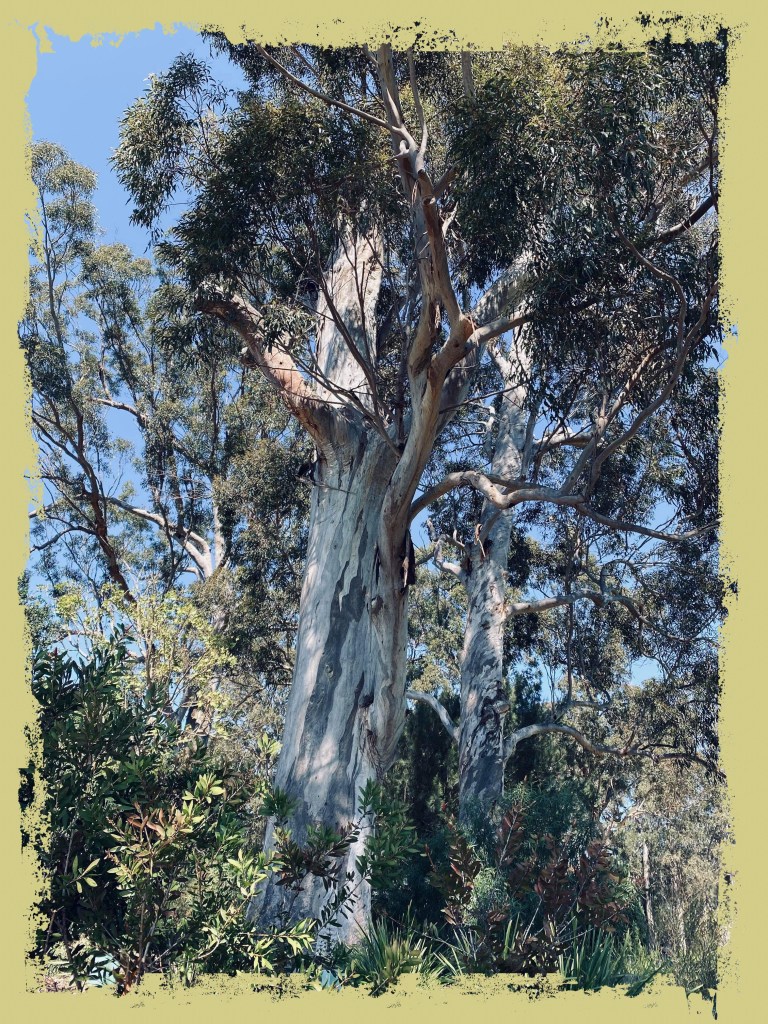
Sitting in this park, there’s these massive old Silver Gum trees twisting their way easily 50 metres into the sky. Looking scraggly, yet majestic, and steely blue and silver grey colours curling their way around 3-4 metre diameter tree tree trunks. Bits of bark ready to fall off at the slightest hint of a breeze, but yet just blowing calmly as the breeze increases enough that I put on my jacket, and pick up my empty coffee cup that’s blown over.
The stories these trees could tell – the families of animals they have housed, the storms they have weathered, the amount of people that have become introspective over their absolute beauty – and still they just keep growing. Not impervious to impact of the world around them. They have knots in their trunk where branches have been taken away due to whatever force of nature decided to hit at that growing stage. Even the whole centre of one trunk is completely rotted away, right next to the branch where clearly a chainsaw has been taken to it for whatever human-determined purpose.
As I contemplate that thought, I’m left with a different thought – these trees have been tended to. Not told what to do, not directed to grow, just given the space to do what they are designed to do, and supported where necessary. Branches being removed occasionally, nutrients added to the soil to support the trees base, bark cleaned up off the ground, and then just letting nature take it’s course. That thought that these amazing, majestic, but imperfect trees have been tended to, really does lead me to think that the hardships that change us irreversibly, actually can have the power to make us unexpectedly amazing! That might feel like a leap in thinking, but these trees really are phenomenal in their intricate beauty, and aside from the Huon Pines in Tasmania and Giant Redwood Trees in California, really are favourites.
Now I just need to find the space to tend my own self, make peace with my history and enjoy the unexpectedly amazing!
I bought a ring today – one that I really like, for US$20 – on what is the 8th year Anniversary of the surprise engagement to my second husband. Thing is, the divorce from said husband is about to be finalised through court.
The irony of this situation though, is he spent 2 years asking me what type of ring I liked, and then surprised me with a ring that was soooo small it didn’t even fit on my little finger, and with sapphires! – not my birthstone, or actually a colour I am drawn to – but it is a stone that he liked.
He had found some sapphires and other stones gem fossicking years before he met me, and some of the green stones were certainly pretty, but he didn’t even get a ring made with those stones (apparently we couldn’t afford it).
And now, just today, I have bought a silicone ring (Enso Rings) – yep, silicone – because now that I have space to know who I am and what I really like, it’s so totally me! My last engagement ring, I paid to have it repaired twice (I still own it, and it’s currently broken), because I am a size V in a standard ring, and it had to be resized up from a K – so of course, there’s a major weak link in the ring. And of course, I’m classicly clumsy, so the ring would crack or bend in the added section – something a silicone ring will NEVER do! And honestly, if for any reason, I do take it off and misplace it, I won’t feel bad for losing it – it’ll be a sentimental loss, and I won’t have someone making me feel bad about it.
And the other irony about wearing a silicone ring is that it is effectively a plastic – and I enjoy recycling and repurposing stuff! Makes no sense to me – but I’m ok with that!
So I’ve spent a couple of days now in pain with my back spasming and I feel like no one is available to help. Is that because I’ve cried for help when I haven’t needed it? I received NDIS funding 3 and nearly 1/2 years ago and in that time I have had a myriad of support workers come in and help me. So much of that help I’ve had to almost fein that I’ve needed it – not in the way you think though. And not as a hypochondriac, but more in a use-it-or-lose-it fashion or even in a proactive vs reactive response.
I’ll explain that a little further – some people go to the gym to build muscle, some people go to the gym to do cardio and stay healthy and fit, but those with chronic illness generally go to the gym to build our core strength so we don’t hurt ourselves. But to watch us at the gym is interesting to say the least, as we tend to do these really light exercise as almost Pilates or yoga style, to build our core strength so that if we fall/when we fall, we can pick ourselves back up again. How this presents after 6 or 12 months is that our bodies don’t look like they’ve changed – and in a way it looks like we are pretending to go to the gym. What we’re actually doing is being proactive …
I think this is why I find it so hard to do my personal emergency plan. When I actually go ahead and think about it, who do I really trust that’s going to be there at the drop of a hat (in the case of an emergency)? There literally is no one (not that I have no-one that supports me, just that there is no one that drops everything and responds, like ‘ideal family’ might) – I’ve either said no to them due to my impossibly high expectations, or they’ve got their own things going on – both are likely and reasonable.
This leaves me in a position of needing to proactively build my support network – and if I’m honest with myself, it’s where I stop being proactive. It’s why I end up in this ugly space of “am I crying wolf?”
Communication with purpose is tiring, and of course, there’s the little winey voice that chimes in and says “why do I need to put in all the effort to build relationships so I can have supports when my body or mind fail?” Communication with purpose is tiring, because you then spend a lot of time believing that relationships aren’t real, and people are just being nice to you because they feel sorry for you. And then I cycle back to “is the only reason I have a friendship/relationship is because of their future use to me?” Bit of a narcissist way to view relationships, right?!
But then again, having NDIS controlling your access to supports you will need in the future, does tend to lead to this type of thinking. It’s the kind of thinking that is supposed to lead you to anticipating future need. So why write this post?? Full circle thinking – I am consistently surprised by the need when it arises, and not-surprisingly, it’s always damn inconvenient!
So, am I really crying wolf, or am I just a little bit overwhelmed by the basic conundrum of ‘unexpected happening’? And given that we are globally still amist a Covid-19 pandamic, I suspect all that really happened, is that I was thrown by my body doing something it hasn’t done in a while (but I have MS, and it does do weird things), and due to Government regulations, I am unable to take my normal path to recovery!
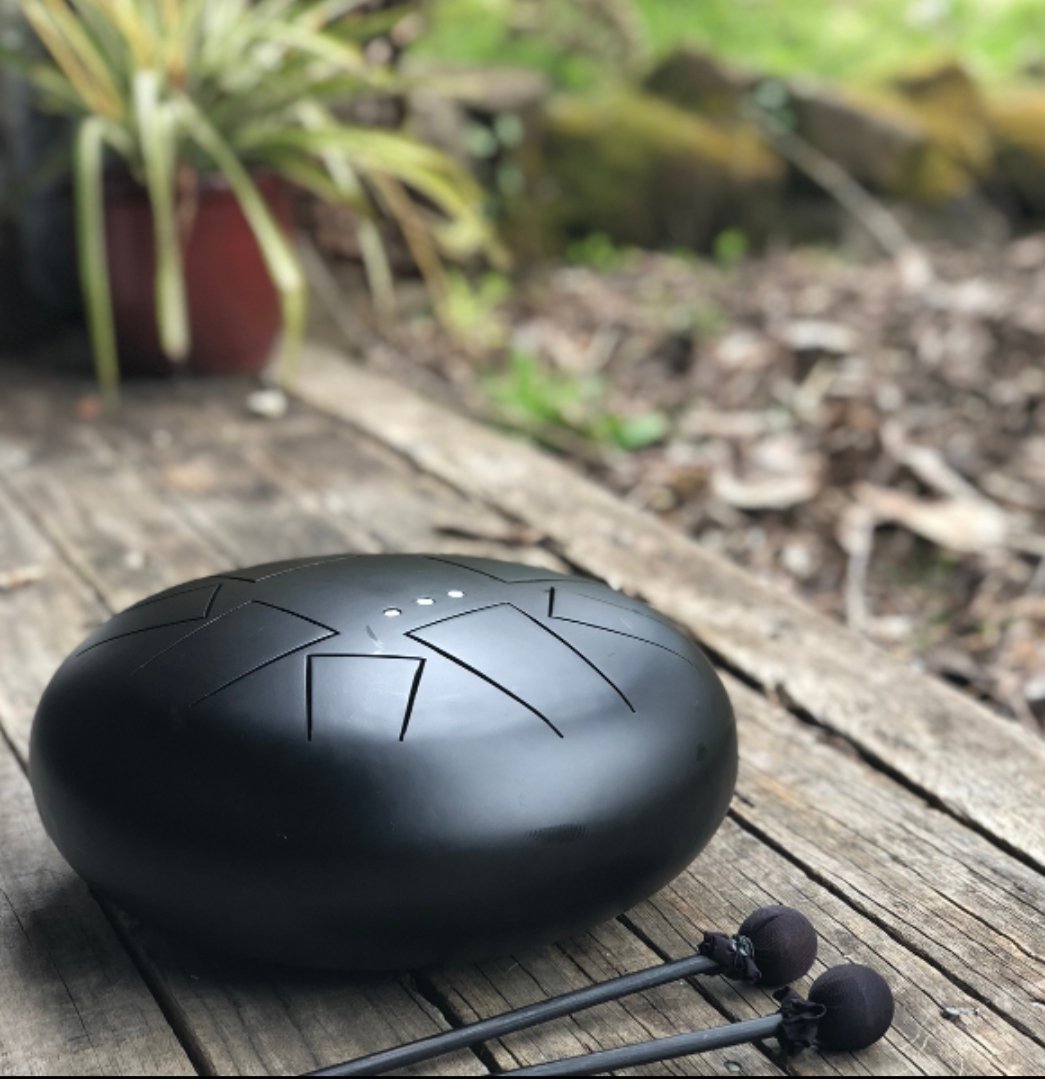
There’s not too many times in life, that an inanimate object can bring tears to my eyes, and warm my soul. But today I received delivery of one such object … A beautiful handmade black metal UFO pentatonic drum.
The very nice, but completely unaware postie dropped a box at my front door at around 3pm, without a care as to what might be included. After locating a hammer and chisel to pry my new self-love gift from its well-secured wooden box, revealed was this oddly UFO shaped metal thing – exactly what I was expecting, but somehow infinitely more precious.
Steel tongue drums, or their variant names, haven’t been around all that long (compared to the history of time), but the concept of banging on something to make a melodic sound has been. I’m totally awed by the concept that I, the human with little to no musical skill (we can unpack that issue later!), can make inspiring sounds within seconds of having this amazing drum in my hands. It’s a truly beautiful and gifted thing, to be able to sit and resonate with the vibration of sound coming from a modified propane tank!
The tears may be from being in isolation (I doubt it – I was a happy hermit before covid), or from my randomly emotive MS state, either way, the vibration of sound seems to stir up the connective tissues of my body, and feels healing to the touch. All the 8 notes on each of the ‘tongues’ are tuned together, that no matter which non-talented way you bang on them, the results are soul satisfying.
And the biggest benefit to this little UFO? … The value to a 5yo who senses the world very differently – she can bang on this thing till her heart is content (you can’t break it – it’s a steel drum!), and the vibrations reach all the way to her little toes. I think our UFO is going to be well loved for a long time to come!
On a practical note, steel drums can be found under a number of different names, and I purchased mine from the inspiring and gifted Alli, and all her musical offerings can be found at Oh My Musical Goodness online.
What do healthy relationships look like? Every Monday and Thursday afternoon at 4 p.m. I spend somewhere plus an hour organising for my 5 year old to spend quality time via a video link with her father in a zoom session. In a decision made by the Court, even when coronavirus pandemic is over, these twice-weekly video conversations will continue.
What am I teaching a five-year-old about healthy relationships? That we should continue to communicate with people just because they have a biological or historical relationship with us? That despite the concerns have arising from un-acknowledged domestic abuse, I believe that my child should attempt to have a safe and meaningful relationship with her father? That just because someone, who doesn’t fully respect our personal situation, gets to dictate to us who to pursue relationships with? That I’m all talk and no action – yep, I talk about having relationships with people, and yet me, her own mother (and the one she spends significant time with) doesn’t choose to have an intimate personal relationship with anybody. I really want to teach her so much more than these basic idioms but I do feel that I need to recover from my own issues before any of that happens. So again, we digress.
If only I could segment out these video sessions as one part of my life? What do I like about them? What do I not like about them? What’s the impact of them on Miss J’s world? On my world? What’s the impact of them on ASD? What’s the impact of them on me regarding the “parenting of the parent” behaviours and domestic abuse? Not in this post – but I will come back to answer these questions …
In the video call before the Easter Weekend, the 5yo’s father says to her, to end the conversation, “be good for Mummy, otherwise the Easter Bunny won’t come”. He say’s this without apparent consideration of who she is, and how she processes the world. He has been called to task before about calling her a “cheeky little shit” in jest, to which he put up a social media post to justify his position – Miss J was only 4 at the time, and certainly has always had amazingly receptive language skills. His base view has been, and apparently seems to still be, “I was raised with these statements and views, and I turned out ok, so what’s the harm?”
…. And yet, if we are to truly dissect this issue, I’m more than fine with allowing said 5yo to believe in the Easter Bunny! I just don’t believe we should link ANY behaviours of children (which could be caused from the way a person processes the world, health, parenting styles, and a myriad of other outside or internal influences), to a global celebration concept, and the characters that are linked to it. ie, Easter Bunny and Santa Clause comes to all who believe – it’s just that simple.
Quote from an article on Kidspot reads “Children who make wrong choices with their behaviour absolutely do not deserve to be shamed – because, they are kids! Part of being a child is stuffing up so they can learn how to make a better choice the next time. Yes, children need boundaries, and yes, they absolutely need limits, but that’s the job for parents, not a fictional character!”
I don’t know of any way to co-parent effectively with a person that refuses to make any admissions to their impact on others during an unforseen in our lifetime, global pandemic! For now, Happy Easter!! 😀